About Empathetic Learning
Many have identified the human being's ability to empathize as one of it's distinguishing characteristics. But empathy is not limited to understanding another's challenges. Empathy is the method to learn how others perceive and experience their worlds.
Children begin to develop the empathetic impulse starting from a young age, and one of the main goals of all early childhood education is to help further this development. Children learn to understand the results of their actions, and learn to read the emotions of those around them. They learn to listen to others, and they learn to speak about themselves. In other words, children can begin to learn to both describe the worlds they occupy and listen to and relate to the worlds of others.
Beginning to be able to describe their worlds and access the worlds of others is a very important development. If we reorient the goal of education as not about the facts one must learn but the worlds we wish to help children occupy, whether it be helping a child relate to the world of someone who is being bullied, or the the pleasure a writer feels setting a scene, or a physicist concisely describing phenomena with an equation, or a biologist's fascination with the myriad forms of life, we see that learning is about relating to and making for oneself the worlds that others occupy. Learning is fundamentally an empathetic activity.
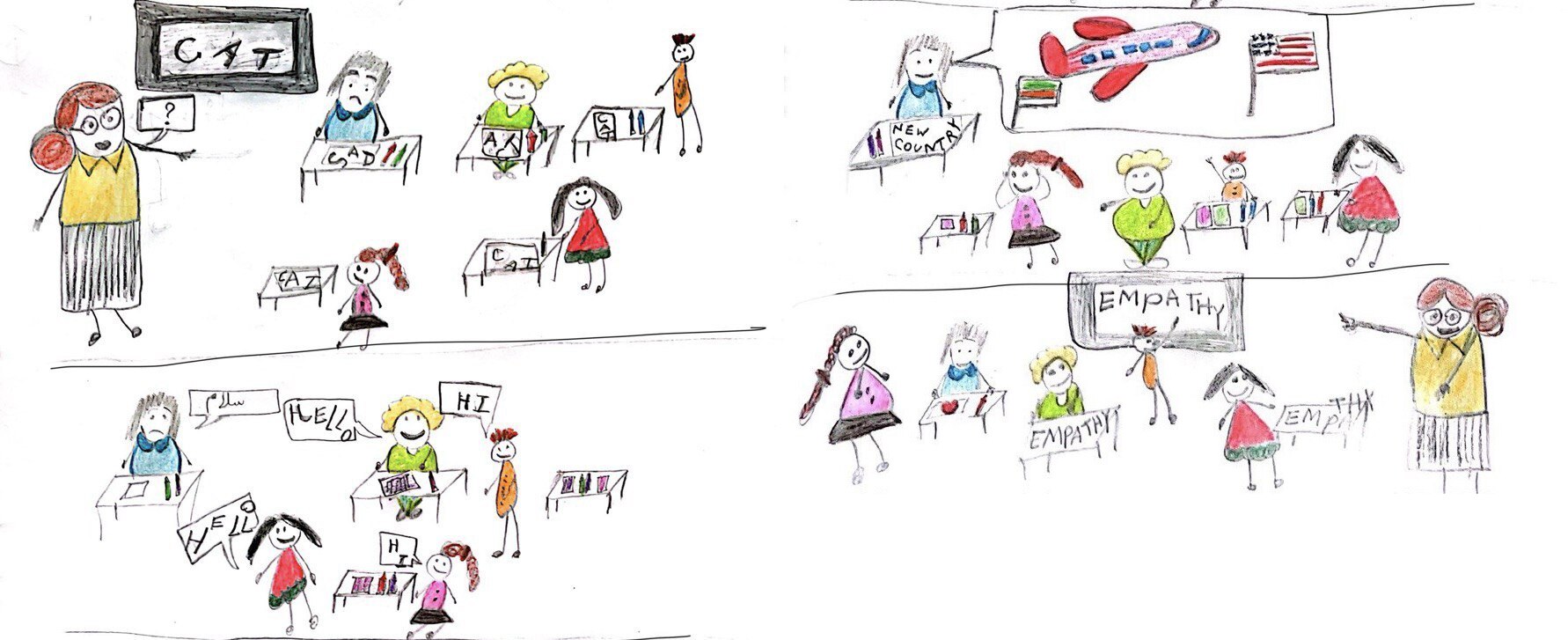 S. (age 6) learning to empathize with a new classmate who has just immigrated to the US.
Compose Theme Docs Clarity Theme Docs